
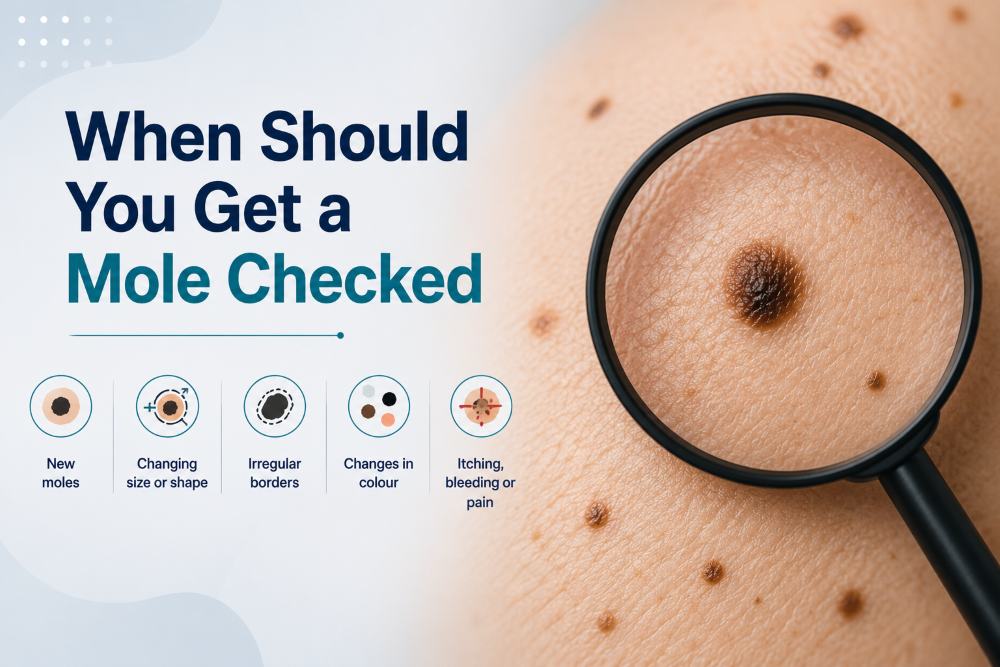
You should get a mole checked if it is new, changing, itchy, bleeding, painful, crusting, oozing, not healing, or looks different from your other moles. Most moles are harmless, but some mole changes can be an early warning sign of melanoma or another type of skin cancer.
In Australia, where UV exposure is high, it is sensible to take new or unusual skin spots seriously. A GP can assess the mole, look at your skin cancer risk, examine the spot with appropriate tools, and advise whether it needs monitoring, biopsy, removal, or referral.
This article is general information only and does not replace medical advice. If you are worried about a mole or skin spot, book a GP appointment for individual assessment. For urgent or severe symptoms, seek urgent medical care.
When Should You Get a Mole Checked?
You should get a mole checked when it changes in size, shape, colour, texture, height, sensation, or behaviour. You should also book a mole check GP appointment if a new mole appears in adulthood, a spot looks unlike your other moles, or a sore keeps scabbing, bleeding, reopening, or failing to heal.
A mole does not have to look dramatic to deserve attention. Some suspicious moles are small. Some melanomas do not follow the classic ABCDE rule. The safest approach is simple: if a mole is new, changing, unusual, or worrying to you, have it checked by a doctor.
A GP skin check in Australia is appropriate when you have:
- A mole changing colour, shape, or size
- A mole bleeding, crusting, oozing, or ulcerating
- An itchy mole, a painful mole, a tingling mole, or a tender skin spot
- A new mole in adulthood
- A mole that looks different from your other spots
- A sore that does not heal within a few weeks
- Many moles, fair skin, or a family history of skin cancer
- A skin spot on the scalp, back, soles, palms, nails, or between the toes
What Can a Normal Mole Look Like?
A normal mole is usually a small coloured spot on the skin. It may be flat or raised. It may be light brown, dark brown, pinkish, skin-coloured, or almost black, depending on your natural skin tone and hair colour.
Many harmless moles are:
- Similar in appearance to your other moles
- Even in colour
- Round or oval
- Stable over time
- Smooth-edged
- Small and not rapidly growing
However, “normal-looking” is not always easy to judge at home. A mole can be harmless even if it is raised. A mole can be darker than another mole without being cancerous. Children’s moles may also change slowly as they grow.
The key point is change. A mole that used to look one way and now looks different should be checked. A new or unusual spot should also be checked, especially in adulthood.
What is Melanoma?
Melanoma is a serious type of skin cancer that starts in the pigment-producing cells of the skin, called melanocytes. It may appear as a new spot or as a change in an existing mole, freckle, or skin lesion. A suspicious mole is not always melanoma, but new, changing, bleeding, itchy, painful, or unusual-looking spots should be checked by a GP because melanoma can spread if it is not found and treated early.
Key Signs a Mole Should Be Checked by a GP
A suspicious mole is not diagnosed by a single sign. Doctors look at the whole picture, including the mole’s appearance, symptoms, history, your risk factors, and whether the spot has changed.
Book a skin check GP appointment if you notice any of the following signs.
A Mole Changing Colour
A mole changing colour should be checked, especially if it develops uneven shades or patches of black, brown, red, white, grey, or blue. A mole that becomes much darker, lighter, or blotchy may need assessment.
Colour change does not always mean melanoma, but it is an important sign to take seriously.
A Mole Changing Shape or Border
A mole that becomes uneven, jagged, notched, blurred, or poorly defined should be checked. Healthy moles often have a more regular edge, while suspicious moles may appear irregular or extend into the surrounding skin.
A mole changing shape over weeks or months is more concerning than a mole that has looked the same for years.
A Mole Changing Size
A mole changing size, especially one that grows quickly or steadily, should be assessed. Larger moles are not always dangerous, and small spots can still be concerning. What matters most is whether the spot is getting bigger or evolving.
A Mole That Looks or Feels Different
Sometimes the best warning sign is that a mole simply does not match the rest of your skin. It may stand out because it is darker, lighter, larger, redder, higher, or shaped differently.
This is known as the “ugly duckling” sign.
ABCDE Mole Check: Simple Warning Signs to Know
The ABCDE mole check is a useful way to remember common melanoma warning signs. It is not perfect, and not every melanoma follows it, but it can help you decide when to see a doctor about a mole.
| ABCDE Sign | What It Means | When to Book a GP Check |
| A: Asymmetry | One half of the mole does not look like the other half. | The mole looks uneven, lopsided, or irregular. |
| B: Border | The edge is notched, blurred, jagged, scalloped, or spreading. | The outline has changed or no longer looks clear. |
| C: Colour | The mole has different shades or uneven colour. | You notice black, brown, red, white, blue, grey, or patchy colour changes. |
| D: Diameter | The spot is getting bigger. | A mole is growing, whether it is larger or smaller than 6 mm. |
| E: Evolving | The mole is changing over time. | Is there any change in size, shape, colour, height, surface, bleeding, itching, or sensation? |
The “E” for evolving is especially important. If a mole is changing, book a GP appointment rather than waiting for it to meet all the ABCDE signs.
What is “Ugly Duckling” Mole?
An ugly duckling mole is a mole or skin spot that looks noticeably different from the other moles on your body. For example, it may be darker, lighter, larger, oddly shaped, raised, or changing while your other moles look more similar.
The key idea is that it “stands out from the crowd.” This can be a warning sign, Cancer Council Australia says to see your doctor if a mole looks different or if a new mole appears after age 25.
An ugly duckling mole may be:
- Much darker than your other moles
- Much lighter or pinker than the surrounding spots
- Larger than your other moles
- More irregular in shape
- More raised or rough
- The only spot that keeps changing
An ugly duckling mole is not automatically cancerous. However, it should be checked because it may be easier to notice than subtle ABCDE changes.
Itchy, Bleeding, Painful, Crusting, or Oozing Moles
A mole that becomes itchy, painful, tender, bleeding, crusted, oozing, ulcerated, or keeps scabbing and reopening should be checked by a GP. These symptoms do not always mean skin cancer, but they are changes that should not be ignored.
Sometimes a mole may bleed or feel sore because it has been scratched, shaved, bumped, or rubbed by clothing. However, you should book a GP mole check if the bleeding occurs without a clear injury, keeps recurring, or the mole does not heal as expected.
You should arrange a skin check GP appointment if you notice:
- Persistent itching, tingling, or burning
- Pain, tenderness, or sensitivity
- Bleeding without a clear injury
- Repeated scabbing or crusting
- Oozing, weeping, or ulceration
- A sore that does not heal within a few weeks
- A spot that heals and then breaks open again
- A mole that becomes inflamed, swollen, or irritated
These signs can happen for reasons other than melanoma or skin cancer. A mole may be irritated, infected, injured, or affected by another skin condition. However, because suspicious mole changes can sometimes include bleeding, crusting, itching, pain, or slow healing, it is safer to have the spot assessed rather than waiting for it to get worse.
New Moles in Adulthood and Changing Moles
A new mole in adulthood should be taken seriously, especially if it appears after the age of 25, looks different from your other moles, or continues to change. Most moles develop during childhood, the teenage years, or early adulthood. While a new mole is not automatically skin cancer, it is worth booking a GP mole check if the spot is new, unusual, growing, or changing.
Changing moles are also important to monitor. A mole should be checked by a GP if it changes in size, shape, colour, height, texture, or symptoms over several weeks or months. This may include a mole that becomes darker, develops multiple colours, spreads unevenly, becomes raised, loses its clear border, or starts to look different from the rest of your moles.
You should book a skin check GP appointment if you notice:
- A new mole after adulthood
- A mole that is growing or spreading
- A mole changing colour, especially if it becomes darker or develops several shades
- A mole changing shape or becoming uneven
- A mole with a new, raised, rough, scaly, or crusted surface
- A mole that looks different from your other moles
- A mole that has changed since your last skin check
- A new spot, freckle, or patch that does not look normal for your skin
Skin Cancer Can Appear Anywhere
Many people only check their face, arms, and shoulders because those areas get the most sun. That is a good start, but skin cancer can appear anywhere on the body.
When checking your skin, include:
- Scalp
- Ears and behind the ears
- Neck
- Back and shoulders
- Chest and stomach
- Arms, hands, fingers, and nails
- Legs and feet
- Soles of the feet
- Palms
- Between the toes
- Under fingernails and toenails
- Areas usually covered by clothing
Ask a partner, family member, or trusted person to help check hard-to-see areas such as your scalp and back. Parents can also watch for new, changing, or unusual spots on children, while remembering that some moles can grow gradually as children grow.
Who Is at Higher Risk of Skin Cancer?
Anyone can develop skin cancer, including people with olive, brown, black, or very dark skin. However, some people have a higher risk and should be more proactive about skin checks.
You may be at higher risk if you have:
- Fair or freckled skin that burns easily
- Red or fair hair
- Light-coloured eyes
- Many moles or irregular moles
- A family history of melanoma or skin cancer
- A personal history of skin cancer
- A history of severe sunburn
- Outdoor work or frequent outdoor sports
- Long-term UV exposure
- Past solarium use
- A weakened immune system
- Sunspots or visible sun damage
If you are at higher risk, speak with your GP about how often you should have a professional skin check. Some people may need regular review, photography, dermoscopy, or referral depending on their risk profile. For broader preventive care, you may also find Health Assessments helpful.
How to Check Your Skin at Home
To check your skin at home, look over your whole body in good lighting and watch for any new, changing, unusual, or symptomatic moles or skin spots. Home skin checks do not replace a professional skin check, but they can help you notice changes earlier.
A simple home skin check includes:
- Use good lighting. Check your skin in natural light or a bright room so you can see moles, freckles, and skin spots clearly.
- Use mirrors. A full-length mirror and a handheld mirror can help you check your back, shoulders, neck, buttocks, and backs of the legs.
- Check your whole body. Look at your face, ears, neck, chest, stomach, arms, hands, legs, feet, soles, palms, between the fingers and toes, and under the nails.
- Check your scalp. Part your hair into sections, or ask someone you trust to look at your scalp, hairline, and the area behind your ears.
- Compare your moles. Look for any mole that is new, changing, or different from the other moles on your body.
- Watch for changes. Pay attention to changes in size, shape, colour, border, texture, or height.
- Notice symptoms. A mole that becomes itchy, painful, bleeding, crusted, oozing, tender, or slow to heal should be checked.
- Take photos if needed. Clear photos can help you compare a mole over time. Try to take photos in similar lighting and from a similar distance.
- Book a GP skin check if you are concerned. Smartphone photos can help with tracking, but they should not replace a professional skin check if something looks unusual or worries you.
When Might a GP Arrange Biopsy, Removal, or Referral?
A GP may arrange a biopsy, removal, or referral when a mole looks suspicious, has concerning changes, or needs specialist assessment. The decision depends on the lesion’s appearance, your risk factors, and the clinical findings.
A biopsy means a sample, or sometimes the whole lesion, is removed and sent to a pathology laboratory. Pathology testing checks the cells under a microscope. This helps confirm what the spot is.
A GP may refer you to a dermatologist or skin cancer specialist when:
- The lesion looks suspicious or complex.
- The spot sits in a difficult area.
- You have many atypical moles.
- You need specialist mapping or monitoring.
- You have a strong personal or family history.
- The biopsy result needs specialist management.
Referral does not mean the spot is definitely cancer. It means the GP wants the right level of assessment and care.
When Should You Get a Mole Checked?
You should get a mole checked when it is new, changing, unusual, itchy, bleeding, painful, crusting, oozing, or not healing. You should also book a GP appointment if a mole looks different from your other moles or simply worries you.
Smith Street Medical provides GP-led assessment for concerning moles and skin spots. A GP can examine the area, explain what they see, and calmly and clearly guide the next step. Book an appointment if you are concerned about a mole or would like a professional skin check.
Frequently Asked Questions
Helpful information about booking, availability and what to expect.
No. Many changing moles and skin spots are not cancer. Moles can change due to irritation, age, hormones, injury, or normal skin changes. However, a mole that changes colour, shape, size, surface, or sensation should be checked, as some changes may be warning signs of melanoma or other skin cancers.
Yes. A GP can assess a mole, review your risk factors, examine the spot, use a dermatoscope where available, and advise next steps. A GP may monitor the mole, remove or biopsy it, or refer you to a dermatologist or skin cancer specialist if needed.
You should see a doctor about a mole if it is new, changing, itchy, bleeding, painful, crusting, oozing, not healing, or looks different from your other moles. You should also book a skin check if you have many moles, fair skin, previous skin cancer, or a family history of melanoma.
An itchy or bleeding mole should be checked, especially if the symptoms are persistent, unexplained, or recurring. Irritation from clothing or scratching can cause symptoms, but it is still safest to let a GP assess the mole and decide whether monitoring, treatment, biopsy, or referral is needed.
Not always. A GP is often a suitable first step for a mole check in Australia. Dermatologists are specialists in skin disease and may be recommended if the mole is complex, high-risk, suspicious, or needs specialist assessment. Your GP can advise whether a referral is needed.

Comments are closed