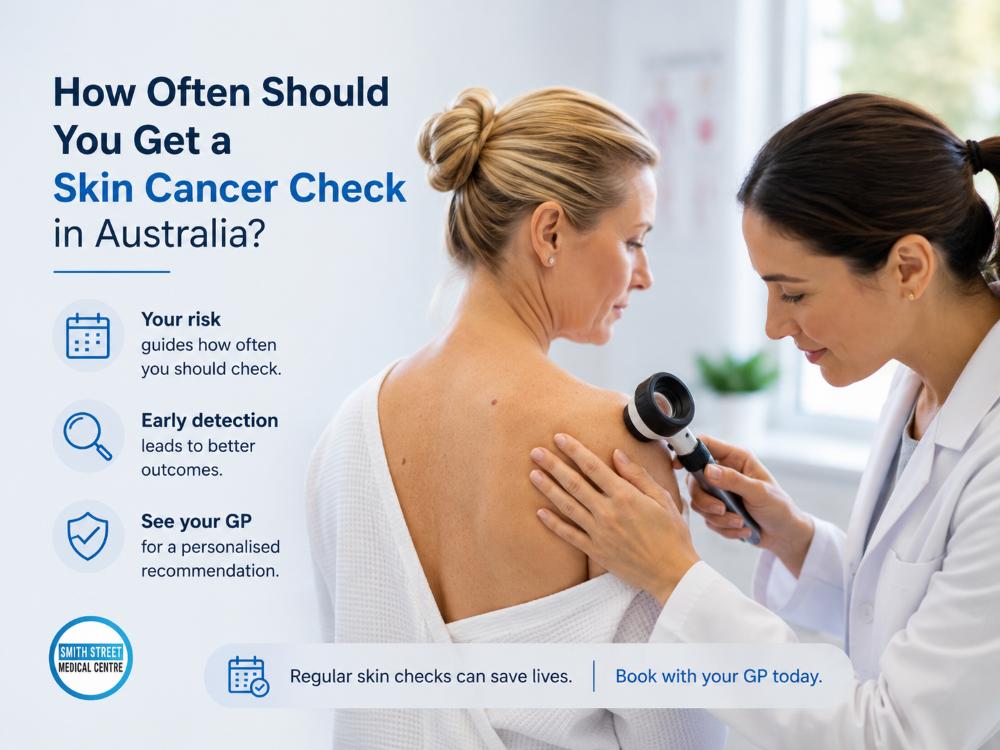
In Australia, the frequency of your skin cancer checks depends on your personal risk, not on a single fixed rule for every adult.
People at average or below-average risk with no concerning spots may only need a one-off check, regular self-checks, and a GP visit if something changes. However, people with higher risk factors may need skin cancer screenings every 6-12 months, or more often if advised by their doctor.
Your skin type, sun exposure, personal history, family history, number of moles, immune system, and GP advice all matter. A good approach is to ask your GP which schedule best fits your risk, rather than assuming everyone needs the same yearly check.
A skin check may feel like an extra cost, but delaying a suspicious spot can cost far more in time, stress, and treatment.
How Often Should You Get Checked Based on Risk?
Your skin cancer check frequency should be based on your risk level.
| Risk level | Possible skin check frequency |
| Average or lower risk | Self-check your skin and see a GP if a spot changes |
| Above-average risk | GP advice; some people may need checks up to every 12 months |
| High risk | Often at least every 12 months |
| Very high risk | May need checks every 6 months with dermoscopy or photography |
NOTE: This is general guidance only. Your GP may recommend a different plan based on your skin, history, and any suspicious spots.
Average or Lower Risk
If you are average or low risk, you may only need a one-off checkup and do not need routine scheduled skin cancer checks. Still, it is important to know your skin. Check your skin for:
- new spots
- changing moles
- sores that do not heal
- anything that looks different from your other spots
If you notice a change, book a GP appointment rather than waiting.
Above-Average Risk
If you have above-average risk, your GP may recommend periodic skin checks, often once a year unless there is a specific concern. This may apply if you have:
- fair or freckled skin
- a history of sunburn
- many moles
- outdoor work
- high sun exposure
- a family history of skin cancer.
High or Very High Risk
If you are at high risk, your GP may recommend regular skin cancer checks every 6-12 months, or more often if specifically advised by a doctor or specialist. This may apply if you have:
- had melanoma before
- had other skin cancers before
- many unusual or atypical moles
- a strong family history of melanoma
- a weakened immune system
- significant sun damage
- a history of repeated severe sunburn
- a spot your GP wants to monitor closely
Very high-risk patients may also need closer monitoring with dermoscopy, clinical photos, or referral to a dermatologist if specialist review is needed.
What Risk Factors Need More Frequent Skin Checks?
You may need more frequent skin cancer checks if your risk of skin cancer is higher. If you are unsure whether you are low, average, or high risk, book a GP appointment for a skin cancer risk assessment.
Common risk factors include:
- Previous skin cancer
- Family history of melanoma or skin cancer
- Fair skin that burns easily
- Red or fair hair
- Light-coloured eyes
- Many moles or unusual moles
- Severe or repeated sunburn
- Long-term outdoor work or sport
- Regular high UV exposure
- Past solarium use
- Weakened immune system
- Significant sun damage or sunspots
When Should You Book a Skin Check Sooner?
You should book a skin check sooner if you notice a new, changing, bleeding, itchy, painful, crusted, or non-healing spot.
Do not wait for your next routine skin check if something changes. See a GP if you notice:
- A new mole or spot
- A mole changing in size, shape, or colour
- A spot that bleeds, crusts, or does not heal
- A sore that keeps returning
- A mole that looks different from your other moles
- A rough, scaly, shiny, or tender patch
- A spot that becomes itchy, painful, or inflamed
Most skin changes are not cancer, but they should be checked properly.
Can a GP Do Skin Cancer Checks?
Yes, many GPs can perform skin cancer checks and assess whether you need monitoring, biopsy, removal, or referral.
During a skin check, your GP may examine your skin, look at moles or suspicious spots with a dermoscope, ask about your risk factors, and advise how often you should be checked.
If a spot needs specialist assessment, your GP may refer you to a dermatologist or another appropriate specialist.
Is Melanoma Screening Different From a Skin Cancer Check?
Melanoma screening is usually part of a broader skin cancer check.
A skin cancer check may look for melanoma, basal cell carcinoma, squamous cell carcinoma, and other suspicious skin changes. Melanoma is one of the more serious types of skin cancer, so any changing or unusual mole should be assessed early.
Despite having one of the highest melanoma rates in the world, Australia does not currently have one universal melanoma screening program for every adult. But Melanoma Institute Australia is leading a 4-year, government-funded Roadmap for a potential National Targeted Melanoma Screening Program, which commenced in March 2025.
The roadmap is supported by the Australian Government’s $10.3 million investment to accelerate work toward targeted skin cancer screening. Until then, GP advice is recommended if you are concerned about your risk.
Final Thoughts: Ask Your GP for a Risk-Based Skin Check Plan
The right skin cancer check schedule depends on your personal risk. So the best next step is to ask your GP what makes sense for your skin.
For some people, regular self-checks and a GP appointment only when a spot changes may be enough. For others, especially those with previous skin cancer, strong family history, unusual moles, fair skin, or heavy sun exposure, annual or more frequent skin cancer checks may be needed.
If you are unsure where you fit, book a GP appointment and ask for a skin check plan based on your skin type, sun exposure, mole history, family history, and past skin cancer history.
Frequently Asked Questions
Helpful information about booking, availability and what to expect.
It depends on your risk level. Some people only need to self-check and see a GP for changes, while higher-risk people may need checks every 12 months or every 6 months.
Not everyone needs annual skin cancer checks. Your GP can advise whether yearly checks are appropriate based on your risk factors. If you are concerned or unsure of your risk, it is reasonable to book a GP skin check and ask what schedule suits you.
People with previous skin cancer, strong family history, many unusual moles, fair skin, heavy sun exposure, immune suppression, or significant sun damage may need more frequent checks.
A new, changing, bleeding, itchy, painful, crusted, scaly, or non-healing spot should be checked by a GP.
Yes, many GPs can perform skin cancer checks and refer you to a dermatologist if specialist assessment is needed.

Comments are closed